
Reptile Surveys
Why Do You Need a Reptile Survey?
All native reptiles are protected under the Wildlife and Countryside Act 1981, with smooth snakes Coronella austriaca and sand lizards Lacerta agilis receiving additional protection under the Conservation of Habitats and Species Regulations 2019 due to their rarity. It is an offence to:


Deliberately, intentionally, or recklessly kill or injure any reptile
Sell, offer, advertise, or transport any reptile for sale, or any parts of live or dead sand lizards or smooth snakes
Disturb smooth snakes or sand lizards (except under licence) in ways that affect their ability to survive, breed, rear young, hibernate, migrate, or maintain their population
Take or destroy sand lizard eggs
Damage or destroy a breeding site or resting place of sand lizards or smooth snakes (except under license)
Disturb sheltering sand lizards or smooth snakes, or obstruct access to a place used for shelter or protection (except under license)


When to Carry Out a Survey
Reptile surveys can be completed between March and October, when reptiles are active and not bromating, but surveys are most effective during April, May, and September when weather conditions are most favourable for reptiles.
Pioneer Environment offers site surveys to assess reptile presence. Starting with a walkover to locate areas where reptiles might shelter, we then conduct presence / likely absence surveys where artificial refuges, made of felt or tin, are placed around the survey area in suitable reptile habitats that are exposed to direct sunlight for part of the day. Over the course of the survey season we visit the site at least seven times, looking for signs reptiles such as live animals or shed skins, and checking the refuges.
We can quickly advise you on whether reptiles are present on your site. If they are, this information gives you a head start in planning a mitigation strategy or applying for any necessary licences. For developments that may disturb common reptiles, an appropriate mitigation strategy is required as part of planning consent. If rare reptiles are affected, a European Protected Species mitigation licence will be needed.
Take a look at our survey calendar for more information.

What Will Pioneer Supply?
We will provide a full site report and, if reptiles are found, we offer a mitigation strategy to ensure legal compliance. This may involve site design, e.g. incorporating suitable habitat and refugia into the site plans, or, if required, we can apply for a mitigation license for your project.
About Reptiles
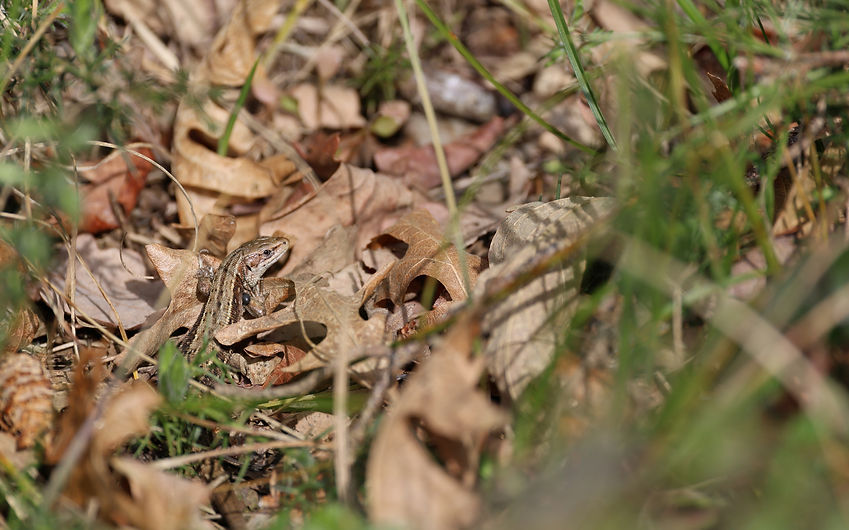
The UK is home to six species of reptile: three snakes and three lizards. They are most commonly found in heathland, grassland, and moorland, but can also occupy any suitably vegetated, south-facing area, including semi-natural habitats. Adders, grass snakes, common lizards, and slow worms are widespread, while smooth snakes and sand lizards are rare and have highly restricted ranges, largely limited to the south of England. Reptiles have a limited ability to move between habitats, making them particularly vulnerable to habitat change, fragmentation, and poor management. In addition to this, snakes are highly persecuted by humans, largely due to fear and negative perceptions. All of the UK’s native reptiles are experiencing population declines, predominantly driven by land-use change.
For more information on badgers, download our factsheet.

About Reptiles
The UK is home to six species of reptile: three snakes and three lizards. They are most commonly found in heathland, grassland, and moorland, but can also occupy any suitably vegetated, south-facing area, including semi-natural habitats. Adders, grass snakes, common lizards, and slow worms are widespread, while smooth snakes and sand lizards are rare and have highly restricted ranges, largely limited to the south of England. Reptiles have a limited ability to move between habitats, making them particularly vulnerable to habitat change, fragmentation, and poor management. In addition to this, snakes are highly persecuted by humans, largely due to fear and negative perceptions. All of the UK’s native reptiles are experiencing population declines, predominantly driven by land-use change.
For more information on badgers, download our factsheet.